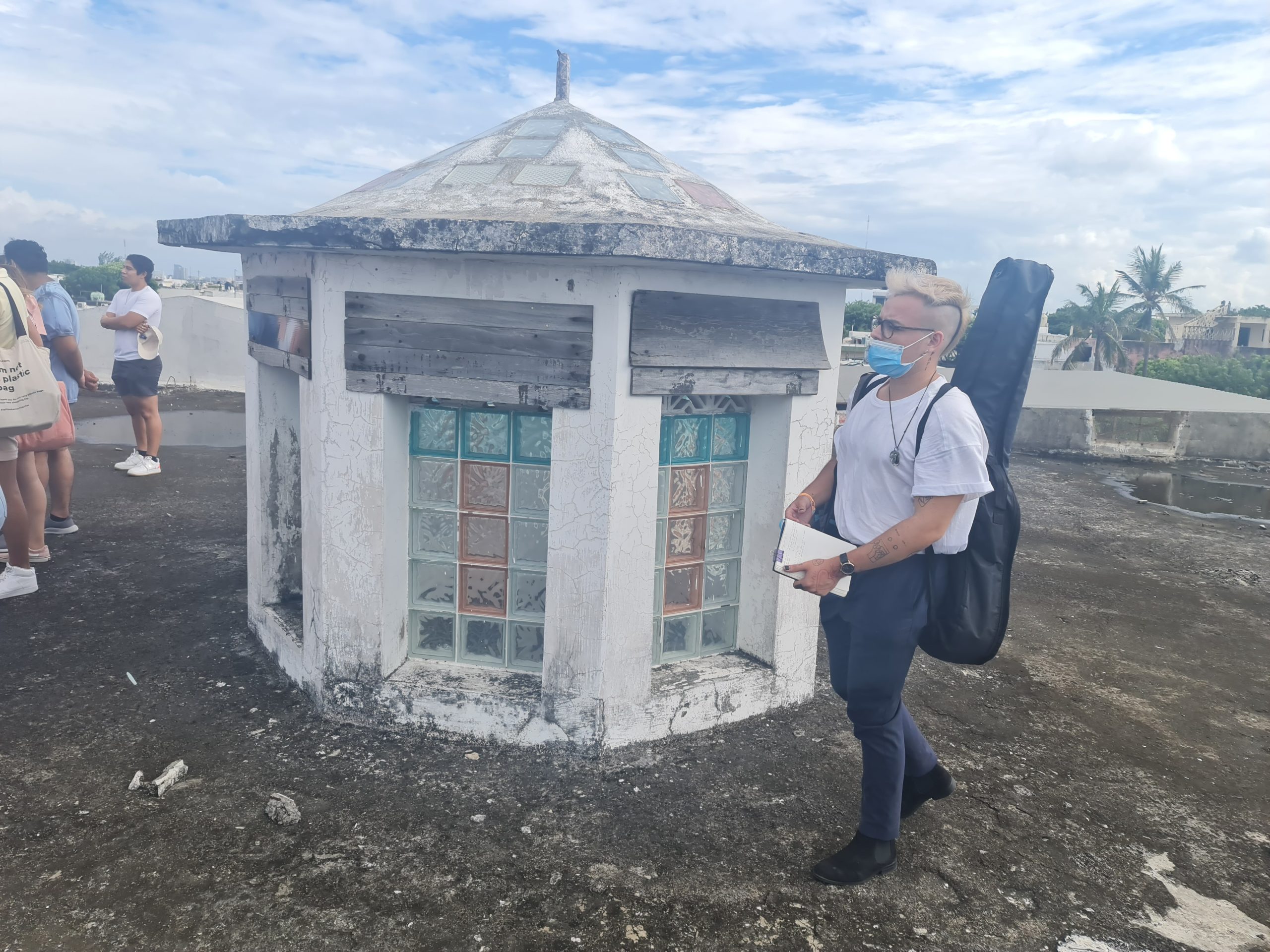
Architecture students of the Cristóbal Colón University were advised by Fr. Alberto Azcona Ontoria for the project of a church.
Cristóbal Colón University received a visit from Fr. Alberto Azcona Ontoria, Sch.P., who traveled from Mexico City to share his experiences and knowledge with the 5th semester Architecture students of Cristóbal Colón University who are developing a church project as part of the “Project Workshop” course, guided by Mtrs. Eduardo M. Gallareta Domínguez and Pedro Levit Arroyo Ventura.
During their stay they visited the church of the Sagrada Familia commonly known as the los Picos Parish, located on Papantla Street in the city of Veracruz. The tour allowed the students to perceive in a deeper way the configuration of the space, its origin and symbolism related to the divine. The reinforced concrete paraboloid roof and its intervention in the enlargement, the importance of light, natural ventilation and the configuration of the spaces related by their use, the material and spiritual function, the forms and the rites, where each element emits a precise, understandable message of transcendence to the encounter with Jesus through the Eucharist.
As a second stop on the tour guided by Fr. Azcona, they visited the Cristóbal Colón School to appreciate from his point of view the chapel and the oratory, with special emphasis on the meaning of each of the elements that make them up.
In the chapel, he pointed out the following aspects: the altar is the place where the sacrifice of Jesus is made present and is the center of the thanksgiving that takes place through the Eucharist; the tabernacle is the place where the Blessed Sacrament is kept, and must be made of solid material; the ambo, according to the structure of each church, must be placed in such a way that it allows the people to hear the word correctly. The seat of the priest celebrant should signify his office as president of the assembly and director of the prayer. The arrangement of pews and chairs, especially in more contemporary churches, should allow the faithful to adopt the various postures recommended for the various moments of the celebration and to approach easily to receive Holy Communion. The choir is arranged wherever it is comfortable for them, as long as it allows them to participate fully.
The last stop was at the Cristóbal Colón University, where he presented the conference entitled “Building a temple for the encounter of God with his people and of the people with their God”.
During the interesting talk in the vicinity of the young students of Architecture he showed several planimetric schemes of the basilica, churches and temples designed by Gabriel Chavez de la Mora (National Architecture Award 2020) Mexican architect and friar, who has dedicated his life to the design of religious spaces.
Fr. Azcona offered examples of works designed under the aesthetic canons of sacred geometry used since the Middle Ages, composed by relationships that mark the square, the equilateral triangle and the circle. He also enunciated the relevance of the golden section used during the European Renaissance and the dynamic triangles applied in the viceregal period of New Spain.
Mtra. Blanca Elena Fernández Martínez