
Coedupia Day 4.
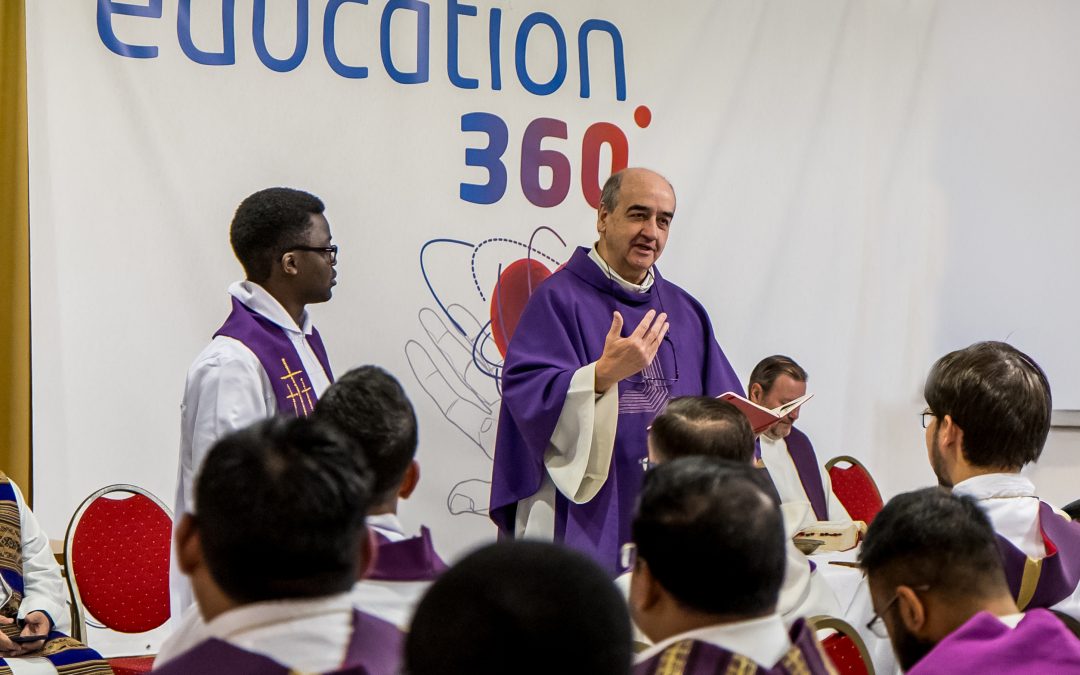
Fr General presided at this morning’s Eucharistic celebration and in his homily recalled the words of the Gospel “Ask and it will be given to you…” “It is a very profound experience that may or may not resonate with our experience, because not always when we knock is it opened to us, and not always when we seek do we find… and that is because this text has to do with God and with an intense experience of God”. This is the experience of faith.
Asking, seeking, calling… Calasanz has left us clues on these three axes: everyday school life, the reception of children, the organisation of the Pious Schools. “If we want to be like him, we have to get closer to his spiritual experience and gradually reach 360 degrees, because integral education needs people who are often integral”. It is a challenge and a risk to often feel small in order to grow in faith, because feeling small is the best way to call on God. Growing in being small. “The fullness is the smallness that is full of God, it is the fullness of Calasanz,” Father Pedro concluded.
Carina Rossa, a professor at the University of Rome, spoke about her personal experience of volunteering and how she discovered God without wanting to. Rossa, who is part of the committee that oversees the Education pact, emphasised the leading role of Pope Francis in his love and concern for schools. “To change the world, you have to change education,” he explained, quoting Pope Francis. “We are convinced of the value of education to change reality, but we are also aware that, as it is conceived, it cannot change reality. That is why we are working on the proposals for change that Pope Francis has suggested,” he explained.
For young people, education means engaging with a situation, educating themselves for reality and from reality. It is about bringing reality itself into the classroom, because only then is learning meaningful. “The future awakens fears and hopes in them, but they trust in collective construction and intergenerational projects,” explained Carina.
Young people want to embark on projects for profound cultural change that bring about change on a global and local level. In this sense, “we perceive reality from a complex, systemic point of view and look for ways to overcome the uncertainty that characterises the present”. For Carina, it is not so much a question of “provoking” a revolution, but of promoting a process of metamorphosis. Education must promote the human and social complexity in which we live and find within itself the power to change this situation. The renewal of education”,” he said, “will come from within to act on students: so that they have the appropriate knowledge, so that they know how to live, so that they face complexity (human, social, economic), so that they know how to understand each other…”.
The professor mentioned some characteristics of this change, such as the appearance of the improbable, which explains that change is not organised, but is the result of many different factors that make it uncontrollable. For Carina, the solution lies in the crisis itself. “Innovations are born from crises, not from institutions or ministries of education”, she explained in her speech, emphasising the virtue of risk, “because the most unthinkable things are born from danger”. Rossa proposes an education that is committed to the territory, that is in touch with reality and in which participation is a process of involvement in the decisions that affect one’s life and the community in which one lives.
The second part of the afternoon was dedicated to the round table on social change. The round table, coordinated by Ernest Botargues (ICCE), was attended by Cristina Costa (BET), Carlos Aguerrea (BRAS), Katarzyna Śledź (POL) and Joan Prat (CAT). The speakers had the opportunity to explain their pedagogical vocation from a Piarist perspective and share experiences in their respective realities, from the Escola Oberta programme implemented in Spain to the socio-communal project in Anzaldo (Bolivia), which identifies problems in the social environment to bring them into the classroom and work with the children. “Social change has the power to touch the hearts of young people and has a broader perspective… and that influences the choices they make in their future,” they explained during the speeches. And they emphasised, among other challenges, living together with those most in need, “living with them to learn to live the world in a different way, through a different logic of life”. Solidarity arises from horizontality, when the marginalised are our friends and change our perspective. “The experience of living with the marginalised changes life,” they said. Among the conclusions, the participants agreed that there is reason for hope, we are on the way, “hopefully we can transfer everything we have experienced these days to the local reality so that we can ensure from within that no one is left behind”. “Diversity is fabulous,” they concluded.
In the first part of the afternoon, Professor Zoltán Szűst, Dean of the Faculty of Education of the Catholic University of Eszterházy, gave a lecture on the challenges of artificial intelligence in education. In his lecture, Professor Szűst said that “Ia” is not really intelligence, “it is a machine that is not able to think, as the human mind does not function as a computer programme and a computer programme cannot be a mind either,” he explained.
AI cannot generate new problems, nor choose the teaching method, nor recognise that students are tired or bored, nor understand the climate in the classroom, nor be a role model, but it is a good teacher. “AI is not interested in what is right or wrong… it will give you answers based on what you have asked it and what it can read. It’s not deeply programmed, it can’t have dreams, it can’t love, it can’t forgive,” he explains the limitations. However, the digital world also offers us opportunities, such as during the pandemic, where it became a very useful tool that allowed us to stay close. For the professor, the risk is that we are entering a forest of unknown information with AI.
We need to stay curious, and paying attention is an educational challenge. With the new, faster and more immediate formats, we can neither convey nor understand anything. “Can young people pay attention during school hours? Attention is also a new challenge,” emphasised Szűst. Even if we allow young people to use the internet for copying, “we are ruining their education, it’s not about them writing a paper, it’s about them reflecting and learning”. It is important for the teacher to realise that he is a machine and has no soul. And in this context, “critical thinking is more important than ever,” he concluded. In the evening, after dinner, participants were able to enjoy a tasting of fantastic Hungarian wines to toast an intense day of living and learning together.


