
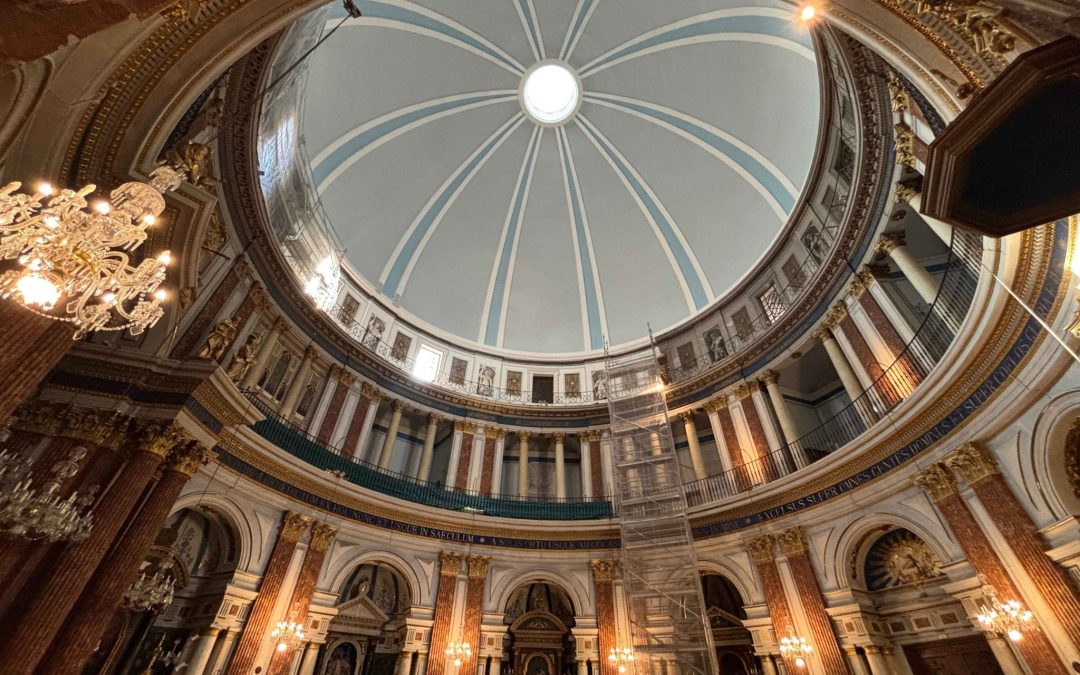
The restoration of the dome of the Church of the Pious Schools in Valencia, carried out between 2018 and 2025, has made it possible to stabilise a seriously damaged eighteenth-century structure, as well as to renew its ceramic tile covering and reopen the lantern. The work, undertaken by a team coordinated by the architect Luis Cortés, combined research, craftsmanship and supervision. This undertaking, the fruit of years of effort by the Pious Schools, has now been honoured with the prestigious Europa Nostra Award 2026 for European Heritage.
The awards jury highlighted that “this intervention, highly complex both technically and organisationally, was successfully carried out through a rigorous multidisciplinary approach. Initiated at local level, it combines structural innovation with advanced research integrated into a regional heritage programme.”
The dome of the Church of the Pious Schools in Valencia is one of the largest masonry domes in Spain, measuring 24.5 metres in diameter and covering an approximate surface of 1,000 m². Built in the eighteenth century as part of the Piarist school complex (“Real Colegio de las Escuelas Pías”), it is an emblematic element of Valencia’s urban skyline and belongs to the European tradition of monumental domed architecture that emerged during the Renaissance.
Before the intervention, the dome was in a critical state. Four large cracks ran through the vault and the drum. Water infiltration had damaged the interior finishes, the roof tiles were broken or missing, and the lantern openings had been sealed. The initiative to restore the dome arose from the Pious Schools and received the support of the Government of Spain and the Generalitat Valenciana.
To carry out detailed studies, 3D laser scanning, drone photography and thermal imaging were used. A full-scale test section and a smaller masonry model were built in order to study the repair methods before the intervention.
The dome’s 32,000 traditional glazed blue tiles, with their characteristic river-like design, were examined one by one. Around 7,000 tiles had to be replaced. A chromatic study identified different shades of blue, which were reproduced through artisanal production. The cracks were filled with lime grout and, in order to improve seismic resistance, certain bands and ribs were externally reinforced with lime mortar and basalt-fibre mesh.
The reopening of the lantern restored natural light to the interior. Sunlight once again illuminates the altar. The lantern also recovered its original polychromy, and the ornamentation of the dome was restored.
The project also included a continuous monitoring system. Sensors measure temperature, humidity, CO₂ and structural movement. Through documentation and 3D modelling, a digital twin of the dome facilitates long-term maintenance. The project’s research has been integrated into a regional heritage programme in collaboration with the Polytechnic University of Valencia.
The restoration process was opened to the public through seminars, guided visits and an exhibition that attracted 46,000 visitors. The project also contributed to the vitality of the parish and its local surroundings. In addition, as a social initiative inspired by the restoration of the dome, the project “Tiles for Dana” reuses the clay and silt collected after the Dana storm of 2024 to produce artisanal tiles for charitable purposes.
After the announcement became public, Glenn Micallef, European Commissioner for Intergenerational Fairness, Youth, Culture and Sport, said in his message of congratulations to the winners: “The European Heritage Awards / Europa Nostra Awards 2026 celebrate the extraordinary power of heritage to inspire, connect and transform. In a world in constant change, this year’s winners show how our shared cultural legacy can drive sustainability, foster innovation and strengthen the bonds that unite us.”
For her part, the renowned mezzo-soprano Cecilia Bartoli, President of Europa Nostra, stated: “My warmest congratulations to the winners of the European Heritage Awards / Europa Nostra Awards 2026 on this well-deserved recognition. The projects and people honoured this year demonstrate how heritage can inspire younger generations, strengthen community life and support local economies. In a world marked by conflict, geopolitical tensions and technological change, the need to defend what unites us has become more urgent and more important than ever.”
The winners will be honoured at the European Heritage Awards 2026 Ceremony on 28 May at the Municipal Theatre of Nicosia, Cyprus. This event will be presented by European Commissioner Glenn Micallef and the Executive President of Europa Nostra, Prof. Dr Hermann Parzinger. The President of the Republic of Cyprus, Nikos Christodoulides, will honour the ceremony with his presence as the highest representative of the country holding the rotating Presidency of the Council of the European Union. The Deputy Minister of Culture of Cyprus, Dr Vasiliki Kassianidou, and other distinguished guests will also attend.
During the ceremony, the winners of the Grand Prix and the Public Choice Award will be announced, chosen from among this year’s laureates of the European Heritage Awards / Europa Nostra Awards, each of whom will receive €10,000. It is possible to vote for our candidacy at this link: https://vote.europanostra.org/
The awards ceremony will be broadcast live through the Europa Nostra website.
From the Pious Schools, Bethany Province, we offer our sincere thanks both to Europa Nostra and to the team that made this project possible for the award received, a distinction that strengthens us to continue promoting the care of our heritage.
Betania Communication
