
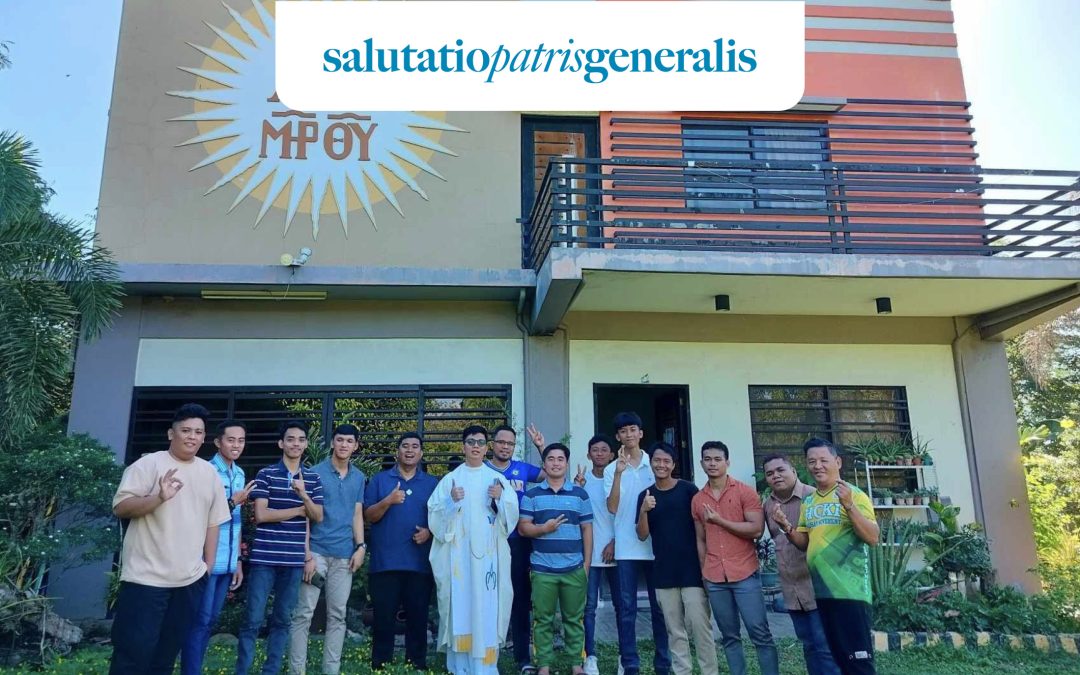
As you all know, I am carrying out a General Visit to Initial Formation in our Order, accompanied by the General Assistants. It has been a very rich visit, in which I am learning a lot about the formative process that our young people are experiencing, a clearly transformative process. I thought I would share some of these learnings with all of you, through some salutatio. In this first one, I decided to focus on the stage of the Pre-Novitiate.
I will try to give names to several of the processes that the young people who enter our houses of formation go through to try to discern – and live – the Piarist vocation that they feel they have received. All of them are real, concrete processes, whose protagonists are the young people who are in our communities. I will outline ten learning processes that I have perceived – many of them still in the early stages, as befits the stage – and in each of them I will propose a question. I will conclude with a simple reflection that can guide our journey.
1-There is a clear experience of vocational calling. There is no doubt about this. It is an extraordinary experience to hear each young person “give a name to the call received.” And this is my starting point: each one of them knows how to express what it means to him that the Lord has called him. That call is made up of prayer, trust, a desire for self-giving, a Piarist experience, fraternal communion, spiritual encounter, profound retreat, daily joy, bold questions, an inner struggle – and sometimes also a family struggle – enthusiasm for a Piarist life that they value, love for Mary and Calasanz and, above all, a profound experience of Christ. It is such a profound experience of the Lord that it provokes them, at a young age, to leave their own home and go to the “land which I will point out to you[1].” The question I would like us to ask ourselves is this: how can we provoke and accompany in our young people the experience of “calling”?
- There is an attractive and progressively realistic image of Piarist life, shaped, above all, through the experience of sharing the community with Piarist religious. Young people know how to “see”. It is a deep look. They know how to admire surrender and dedication, and they also know how to understand the contradictions and pettiness of our lives. They are helped by the example of work and dedication to the mission, and they are challenged by the fact that this work is enormous, and they do not know if they will be able to do it. It helps them to see the Piarist praying with them, and it helps them to understand that tiredness does not prevent that prayer; On the contrary, it asks for it more urgently. They quickly understood the great challenge of every Piarist religious: the passionate balance with which we are called to live the various dimensions of our lives. And they easily learn that balance is about striving for balance, and passion is about living day by day like the first day. They are sponges. What kind of Piarist life do we need to transmit to our young people so that this testimony may help them in their searches?
- They learn that we must learn to pray. I remember that one of the young people, in the personal interview, told me that it was in the pre-novitiate that he understood the disciples’ request to Jesus: Lord, teach us to pray (Lk 11:1), because “it is now that I have realized how much I need to learn to pray and how much I am learning.” Certainly, our young people discover completely new aspects of their prayer experience. They encounter the constancy of community prayer, they experience the value of lectio, they struggle with difficulties in meditation, they enjoy learning to write down their own spiritual experience daily – some call it a “harvest” – they welcome the Eucharist of each day as a gift that impresses them, they learn to dedicate their time in contemplation of the Lord, they begin to perceive what spiritual warfare means, and so on. Let us not assume that we already know how to pray; let us learn from those who are clearly aware that they need to learn. What dynamisms of the spiritual life should be better worked on in our educational and pastoral proposal?
4- There is an enormous openness to integral accompaniment. It is perhaps one of the aspects that I have most strongly perceived when listening to our young people. They honestly seek to be accompanied, and they have the experience that transparency helps them a lot in their searches. Our young people are very clear that their growth process needs to be accompanied in an integral, free, and profound way. The community accompanies, the formator accompanies, the group accompanies, the Province accompanies, specific people who are asked for this mediation – sometimes professional – accompany, many people who are part of the local Piarist life accompany. The key to everything lies on the one hand, in the desire that young people have to move forward and in the growing awareness of the personal challenges that they have to know how to address and, on the other hand, in the concrete experience that accompaniment – especially formative accompaniment – truly helps and sustains. In what ways can and should we better prepare ourselves to know how to accompany? How can we make better use of the recently instituted Piarist ministry of accompaniment and listening?
5-Knowing how to name challenges is another of the keys that I have learned in these months, listening to our young people. I share some of those concrete challenges that have been entrusted to me: trying not to get complacent, not to be afraid of a process of purification, to know how to recognize my wounds and let myself be helped to heal them, to learn to mortify my will, to overcome my tendency to “leave things for tomorrow”, to uproot the dynamisms that do not help me, to know how to respond to my responsibilities, understand that the community also depends on me, etc. A formative process must be challenging, and our young people want and expect it. They do not enter our Order to live in peace, but to strive – as they themselves say – to be increasingly capable of living their vocation. How can we generate communities that take care of the growth process of each of the brothers?
6-Some qualities that they value and try to live. I perceive some that I think are especially meaningful for them: the docility that makes them adults, the humility that helps them aspire to more, the fidelity that allows them to seek new answers, the joy that facilitates a demanding life, the identity that allows them to be close to children and young people by offering their own contribution, the day-to-day that allows them to make a path of authenticity, self-awareness enriched by a real learning of wanting to examine one’s own conscience, etc. What qualities and dynamisms do we need to take care of in our pastoral and formative processes?
- The great criterion: coherence. I think that our young people are as aware of this challenge as they are demanding in their desire to see it in us. I choose the challenge of coherence because I see them with a sincere desire to grow in it and with a clear nostalgia to see it in their elders, in those whom God has placed in their path to accompany them on a daily basis. Coherence is learned as a task and received as an example. And both dynamisms are necessary. It is very difficult for a young person to grow – with courage and conviction – in this challenge if they do not see it in their elders. I perceive various nuances in the coherence they seek and need: knowing how to combine the spiritual life with work well; understand the challenge of living counterculturally; know how to give reasons for their convictions; assume the difficulties and obstacles that society is going to put in front of them; to be well trained in order to be able to give reasons for their convictions; learn to recognize mistakes and make an effort to overcome them; giving value to the day-to-day, understanding that everyday life is the crucible of authenticity, etc. The desire is clear, and so is the need to live it. How do we challenge ourselves to be credible witnesses to what we profess?
- The horizon: making Christ the center of my life. It is exciting to hear our young people desire to “let Christ be all in me” or “give everything to God.” It is very comforting to hear them say that their greatest desire is to set their hearts on God. I know that this experience – undoubtedly foundational – is still in its infancy. But without it, it is not possible to be religious. In more than one meeting of this visit, I have had to change my plans and questions and “narrow” them down to just one: “What does the challenge of configuring yourself to Christ mean to you?” If I have been able to ask this question, it is because they have provoked it. Let me share some of his answers: letting go of what separates me from Him; try to seek His will; to understand that my vows, when I make them, are a call to grow every day; be a servant; never to believe myself better than anyone else; be like the publican in the parable; don’t give up because of difficulties; to be grateful every day for the vocation, because only if I am grateful for it will I take care of it; to understand the way of “lowering myself”, asking Christ to help me to be configured to Him; assume that this is a lifelong task, etc. Knowing how to answer this question, with humility and simplicity, is part of the journey. What are the experiences that can most help our young people discover the central role of Christ in their lives, and how can we enhance them?
- There is a ninth learning that I want to highlight. We can call it “Calasanz’ hunger“. Our young pre-novices have a beautiful reference in Calasanz, they admire and love him, he inspires them. There is no doubt for me: Calasanz is a source of inspiration in his process. But there is also a clear need to get to know him better, to go deeper into him. The openness with which they face the challenge of “getting to know the founder better” makes me think that this should be a permanent attitude in the Piarists. I sense that, if our young people are able to maintain this “hunger” throughout their lives, they will grow more clearly in their goal, which we usually formulate as follows: “to be a new Calasanz”. The clarity and enthusiasm with which they identify with this goal encourages me to remind all of us that this is the challenge of every Piarist and, in accordance with their own vocation, of the various people who discover that their place in the world is the Pious Schools of Calasanz. How can we best present Calasanz in our Piarist contexts?
10-I will take away ten lessons. The last one is fundamental for me: the time dedicated to children and young people, and especially to the poorest. Our pre-novices live, with healthy joy and not a few surprises, various experiences typical of the Piarist mission. They are accompaniers of the Calasanz Movement, they dedicate time in the children’s homes that we run, they participate in the Continuous Prayer, they train altar servers, they share their faith and their life with their companions in the groups from which they come, they organize summer camps, they join the Missions, they participate in the formation processes of our educators organized by the Province, etc. And in all of them I perceive a clear constant: children and young people consolidate their vocation. As it has always been, contact with the raison d’être of the Pious Schools becomes the raison d’être of their vocation. Piarist life is strengthened by the children and young people to whom we dedicate ourselves, and this is true from the first minute of formation. What are the most provocative mission experiences of questions and searches in our young people?
As I said above, I would like to conclude with a brief reflection inspired by these learnings and the training challenges we face.
As you know, our 48th General Chapter approved a new point of the Rules (R162) focused on Initial Formation. I pick up on its contents, because I think it is important that we keep that in mind. “Formation must develop in candidates the ability to exercise their future vocation of accompanying and serving according to the Piarist criteria expressed in the formation curriculum: the spirit of service from the very least, sensitivity to the poor, the self-giving to the mission and to the community, the willingness to educate oneself continuously, the transparency of life, the willingness to be accompanied, the overcoming of clericalism and secularism, training in the integral protection of minors, teamwork.”
Listening to our young people, I perceive an enormous harmony with the formative concerns of the Order. I see them, in general, open to the process and eager to follow the path we propose to them. What they need is for the proposal to be serious, consistent, and clear. As one of the formators with whom I have spoken in recent months said, “you learn to be a Piarist by being a Piarist”.
Receive a fraternal embrace.
Fr. Pedro Aguado Sch.P.
Father General
[1] Gen 12:1
