
This is the question Calasanz asks himself when he meets the young Glicerio Landriani, who is knocking on the doors of the nascent Pius Schools to consecrate his life as a Piarist. It is a deep, precise question. It is the question that we must all always ask ourselves and that must guide the formation process of all young men who want to become Piarist religious.
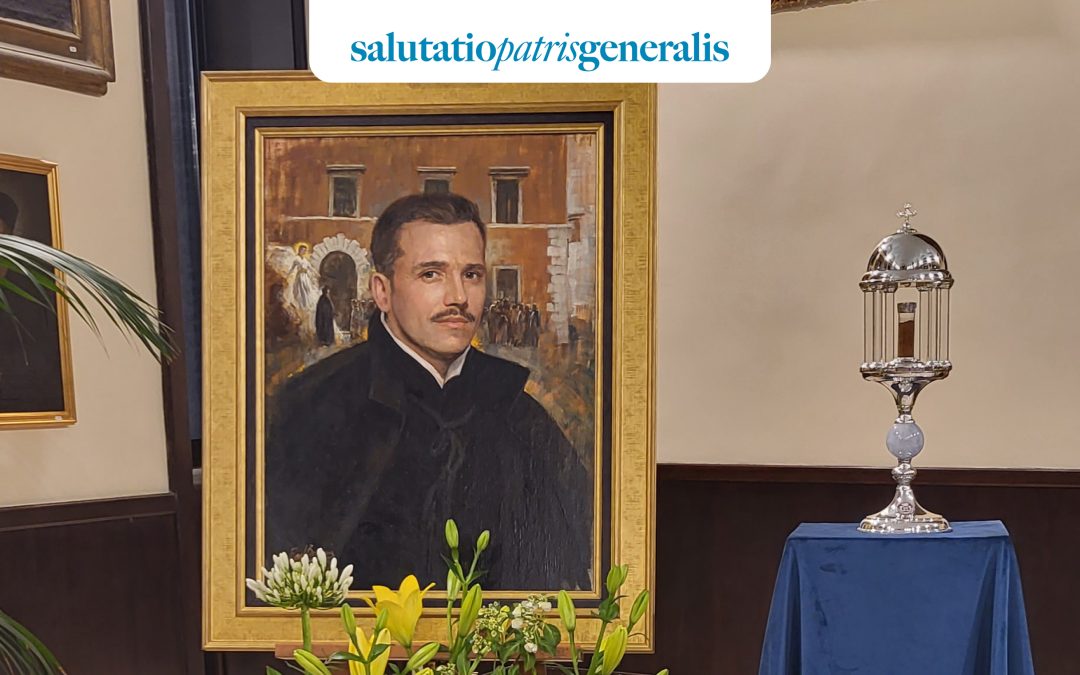
I would like to dedicate this Salutatio to the figure of the Venerable Glicerio Landriani of Christ. At the end of last May, the General Congregation in Rome organised an institutional act on Glicerio to revive and promote his cause for beatification and canonisation. It was a beautiful event in the Calasanctian Family, which included the presentation of a new image of Glicerio, the new reliquary guarding his heart and a simple book on his life and Piarist testimony.
I think it is good for all of us to approach the figure of this young Piarist whom we have set up as a reference of the Calasanz Movement and who has always been much loved by all the Pious Schools. I would like to approach his figure from an inspiring text and from three areas of reflection.
I would like to begin with a short parable from the Gospel (Mt 13:44). The Lord says: “The kingdom of heaven is like a treasure hidden in a field. When a man found it, he hid it again, and then in his joy went and sold all that he had and bought the field”.
I believe that this parable can help us to understand the central point from which Glicerio understood his life and from which each of us is called to understand ours. Glicerio discovered the treasure, the charism of Calasanz. He discovered it with deep joy, hidden in the terrain of the emerging Pious Schools. That was the treasure, that was the land he had to buy.
What are we going to do with the land? I ask myself this question because we can be very absent-minded when it comes to working on the land that hides the treasure. We can dedicate the land to “growing vegetables for the salad” instead of digging deep to find the treasure. Superficial work is enough to grow the vegetables. Or we can erect a big building on the land to hide the treasure. Or we can asphalt it so that it does not sprout uncontrollably or we do not trip when we walk. Or we can surround it with a good wall to protect it and make it impregnable.
We can do many things. But what we must do is what Glicerio did: deepen day by day the search for the treasure that is the charism and live it. Only in this way can we realise the deep desire that we all have, which is “to rekindle the gift of God that is within you” (2Tim 1:6), which is our vocation, the charismatic gift of Calasanz that inspires and sustains our life and mission and the life and mission of the Pious Schools.
I would like to suggest three areas in which we can be challenged by the figure of Glicerio. What does Glicerio offer to the Pious Schools of today? What message does he have for every Piarist? What does he propose to the young people of the Calasanz Movement who have him as a reference? We will try to go into each of the three areas and give some food for thought for each of them.
1-For the Pious Schools.
The General Congregation is determined to promote the cause of the canonisation of Glicerio of Christ. We have many reasons for this, not least the fact that Calasanz himself was the promoter of this cause in June 1620. We have the documents of the statement that Calasanz made at the beginning of the process. He says many things about Glicerio, but we can summarise them in this beautiful statement: “He became so exemplary in this great city of Rome that he can rightly be proposed to everyone as an example and rule of life for a good life in the service of God according to evangelical perfection”[1]. I would like to highlight three teachings that we can and must make use of.
The challenge of holiness. The challenge of holiness. We all know that holiness is a gift, always unearned. But we also know that holiness is a process of trying to live according to God’s will. When Pope Francis speaks of the “saints next door”, he is inviting us to live holiness every day: “In this perseverance to go forward day after day, I see the holiness of the Church in struggle. This is often the holiness ‘next door’, the holiness of those who live close to us and reflect the presence of God, or, to use another expression, ‘the middle class of holiness'”[2].
I believe that the canonisation of Glicerio is an opportunity for the Order to remember that our vocation, like that of every Christian, is an opportunity for holiness. Knowing and appreciating Glicerio’s way – which reminds us that what is essential is not the duration of life but the deep meaning from which we live it – can help us to rediscover this challenge, this “horizon of holiness” in the life of the Pious Schools and inspire our projects, our life and our priorities: “It is not possible for a Christian to think of his mission on earth without understanding it as a way of holiness, because “this is the will of God: your sanctification”(1 Thess 4:3)” [3].
I believe that the canonisation of Glicerio is an opportunity for the Order to remember that our vocation, like that of every Christian, is an opportunity for holiness. Knowing and appreciating Glicerio’s way – which reminds us that what is essential is not the duration of life but the deep meaning from which we live it – can help us to rediscover this challenge, this “horizon of holiness” in the life of the Pious Schools and inspire our projects, our life and our priorities: “It is not possible for a Christian to think of his mission on earth without understanding it as a way of holiness, because “this is the will of God: your sanctification” (1 Thess 4:3)”[4].
The centrality of Christ. The centrality of Christ. In all the Provinces we speak much about this Piarist objective, marked and proposed with absolute clarity by the 48th General Chapter. I believe that we are facing an opportunity to further discover what it means “to “belong to Christ”. The way Glicerio of Christ lived it and witnessed to it is also a particularly important help for the Order.
If we ask ourselves what it means to “live centred in Christ”, there is one way that can explain and understand this with certainty: we think of the Piarists we know, who are a humble and transparent example of what consecration means. A new and consistent reflection on the concept of consecration seems to me a good way to move forward on this path. A reflection that helps to understand to Whom we consecrate ourselves and also, even if it does not sound very good, what we renounce and what dynamics of self-centredness, narcissism or self-sufficiency we must be prepared to overcome.
Attachment to Calasanz. Glicerio had a “privilege”: he was very close to Calasanz. He talked to him a lot, shared many of his concerns and researches, and collaborated decisively with him in the foundation of the Pious Schools. I think that reactivating Glicerio’s process can help us to better understand how important it is to know and love Calasanz. It is our path to holiness. The knowledge of Calasanz, the growing and consistent study of the Founder, the promotion of love for him, are constant in the Pious Schools. And moreover, we have been able to pass it on to many people who have discovered their path of Christian life in Calasanz. Let us go forward.
2-For each Piarist.
I think that in addition to the institutional contributions that Glicerio makes to the Order, there are many others that he can give to each of us in a personal way for the life of our vocation. I would like to suggest three contributions of Glicerio that are particularly important for Piarists who are spending their first years of consecrated life in initial formation. Three pointers for our juniors:
A seeker who finds his vocation. That is what Glicerio lived. He was a young seeker who wanted to respond to what God had planted in his heart. So too are the young Piarists: seekers who want to consolidate their response to the vocation in the Pious Schools. This is a central moment in the formation process. In the first stages of initial formation, even after religious profession, the question “is this my vocation” remains. Until a moment comes when the search becomes an answer and consequently a progressive growth and consolidation. Glicerio expressed this in a letter to Cardinal Borromeo thus. “I am more than sure that this is the vocation of God our Lord for me, and I hope that the Lord will want to use me for his work, which is so important that I marvel that these poor boys, who used to wander about the squares without any restraint for fear of God our Lord, indulging in every dishonest word and evil deed, turn away from hatred and evil in the Pious Schools, engage in exercises of the Spirit and learn Christian doctrine”.[5]
This confession of Landriani is truly profound, in which he expresses his deep experience of vocation: security, longing, surprise, love for the poor… He has found his vocation. This is the experience of every young Piarist.
A young man eager to build Pious Schools. In his short life as a Piarist, Glicerio had two experiences of “building Pious Schools” which I see as symbolic. In March 1617, he is commissioned by Calasanz to receive the founding brief of the Pious Schools. Glicerio receives it, returns “dancing with joy” and hands over the founding brief to Calasanz. It is a symbolic event: he is the one who hands over to the Founder the document “Ad ea per quae” with which Pope Paul V establishes the Pauline Congregation of the Poor of the Mother of God of the Pious Schools.
There is a second, equally symbolic event. Accompanied by Calasanz and Dragonetti, Glicerio goes to Frascati to begin the foundation of the school, the second Piarist school. It is still in operation today. Glicerio’s presence at the founding of this school shows us with great clarity his passion for children and young people, a passion he always lived out of a life of service to those in need and out of a deep desire to bring children closer to friendship with God.[6]
The “building of Pious Schools”, the commitment to the Order and the mission, is something that lies deep in the heart of every young Piarist. And it is something that must be cultivated, worked on and prayed for until it becomes part of the axis of vocation from which each one forms his Piarist identity. This is the young Piarist we need. We need more “glicerios”.
Living each day with passion. This is a valuable key that Glicerio offers to our young people. Perhaps the brevity of his Piarist life helps us to understand the importance of living each moment as if it were the last, with the passion of vocation. I believe that one of the things that we can and must transmit to our young people and that we must accompany in them is this conviction: the secret of being a new Calasanz is in the everyday. There is a very beautiful expression of Calasanz when he talks about Glicerio. He says about him that “he never missed a time or an opportunity to promote the glory of God and the benefit of his neighbour”[7]. I cannot express better this secret of the Piarist life, which is to live every day, every moment of our lives with authenticity. This is the best proposal for the formation of our young people.
3-For the young people and catechists of the Calasanz Movement.
The Calasanz Movement is one of the treasures of the Order. Since its foundation, the General Congregation has placed Glicerio as its referent, waiting to be able to name him as its “Patron”. In the Calasanz Movement hundreds of children, adolescents and young people walk and grow, accompanied by their catechists and the Piarists. It is a journey of life and faith inspired by Calasanz and strengthened by the example of Glicerio’s life. I would like to give three indications that Glicerio offers to the young members of the Calasanz Movement and to those in charge of the Movement.
Living with courage the keys of the Calasanz Movement. Glicerio’s life passionately embodies the values and options we offer our children and young people in the Calasanz Movement. I am talking about things like these: the cultivation of the experience of God and prayer; the community life expressed in the value of the group in which each young person grows; the love of the poor expressed in a growing education of commitment; the education expressed in so many themes and experiences of growth; the choice of vocation that inspires a Calasanz Movement that seeks to accompany each young person in discovering God’s will for their lives; the identification with Calasanz that is presented to each member of the Movement as an accurate guide for their own journey; the inner work that is condensed into a pedagogical accompaniment offered to each young person during their experience in this process, etc. For all these reasons, Glicerio is a good reference for our pastoral offer.
To form authentic educators of the Calasanz Movement. The Calasanz Movement Coordination Team has proposed five work projects. One of them is the “Implementation of the Plan for the Formation of Calasanz Movement Educators at the Order, Demarcation and Presence Levels”. Glicerio is a good teacher of catechists. His tireless work as a catechist for children, youth and adults, as well as his gift for coordinating evangelisation work, have made him an excellent educator in piety in Frascati and in Rome. Hand in hand with Calasanz, he structured the catechesis of the students of the Pious Schools and was introduced to the practise of Continuous Prayer[8]. That is, he embodied in his life two of the great treasures of the Order, the Calasanz Movement and Continuous Prayer. Perhaps one of the best pointers he gives to the leaders of the Calasanz Movement is this: he understood his ministry to the children and youth from the perspective of vocation. That is why he lived it with so much and growing fullness.
To instil in children and young people a growing sensitivity to the concerns of the project of Calasanz. The Calasanz Movement is and should be an opportunity for our children and youth to become familiar with the causes that make up the charismatic project of Calasanz. This must be the direction we must take. And Glicerio can accompany us on this path. Calasanz drew his vocation from his love for Christ and Mary, for children and young people, especially the poorest, and for the Pious Schools. Communicating these priorities to our children and young people and helping them to identify with them, each according to their vocation, is one of the best contributions we can offer them. When they discover and live them, they will know how to shape their vocation with these convictions. Just as Calasanz expected children to have a happy path in life if they were properly educated in Piety and Letters,[9] we all expect the same from the Calasanz Movement, because it is a profoundly Piarist process of integral education according to the keys of the Gospel.
I close this fraternal letter by inviting you to pray: “Lord, who gave the Church in Glicerio Landriani, a Piarist, an example of prayer and love for children and young people by preaching the Gospel to them, grant that we may always seek Your Glory and the benefit of our neighbour; glorify your Servant by granting us, through his intercession, the grace we ask of You. Amen.
Receive a fraternal embrace.
Fr. Pedro Aguado Sch.
Father General
[1] St. Joseph CALASANZ. Opera Omnia, volume X, page 59.
[2] Pope FRANCIS. Apostolic Exhortation “Gaudete et exultate” 7.
[3] Pope FRANCIS. Apostolic Exhortation “Gaudete et exultate” 19.
[4] Pope FRANCIS. Apostolic Exhortation “Gaudete et exultate” 19.
[5] Glicerio of Christ LANDRIANI. Letter to Cardinal Federico Borromeo of September 29, 1612.
[6] Angel AYALA. Speech at the Institutional Act of promotion of the cause of beatification and canonization of the Venerable Glicerio of Christ Landriani, held at the General House in Rome on May 25, 2023.
[7] St. Joseph CALASANZ. Opera Omnia, volume X, page 59.
[8] Ángel AYALA. Speech at the Institutional Act of promotion of the cause of beatification and canonization of the Venerable Glicerio de Cristo Landriani, held at the General House in Rome on May 25, 2023.
[9] Saint Joseph CALASANZ, Constitutions of the Pauline Congregation of the Poor of the Mother of God of the Pious Schools, n. 2.
