
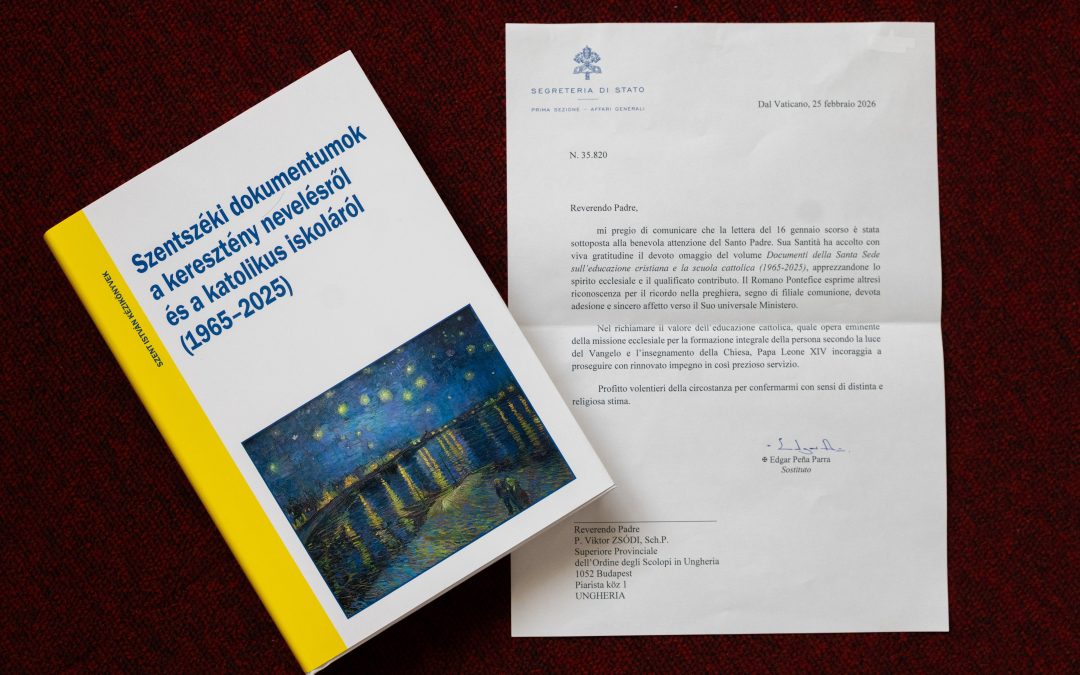
The Holy See has warmly welcomed the volume prepared by the Hungarian Piarists entitled Documents of the Holy See on Christian Education and the Catholic School (1965–2025). According to the letter dated at the Vatican on 25 February 2026, Pope Leo XIV considered the work with “benevolent attention” and received it with deep gratitude.
The letter, signed by Archbishop Edgar Peña Parra, Substitute for General Affairs of the Secretariat of State, underlines that the ecclesial spirit and the comprehensive approach of the volume render an important service to the cause of Catholic education. The Holy Father reaffirmed that education is a priority field of the Church’s mission, directed towards the full development of the person in the light of the Gospel, and encouraged the community to continue this work with renewed commitment.
The publication is not merely a historical compilation of documents: it offers a vision of the principles of Catholic education from the decades following the Second Vatican Council to the present day, and addresses current challenges in detail. Its guidance is useful not only for educators, but also for all those who feel responsible for the formation of the new generations. The aim of the volume is to serve as a point of departure for further reflection and to contribute to a “creative springtime” of Catholic education in Hungary.
In his recommendation, Cardinal José Tolentino de Mendonça, Prefect of the Dicastery for Culture and Education, highlights that the documents not only deal with general educational questions, but also seek to respond to the most pressing challenges of today. As he writes, the work of teachers and educators is “as important as it is silent”, and is indispensable not only for the renewal of ecclesial communities, but also of the whole of humanity.
In his foreword, János Székely, President of the Hungarian Catholic Bishops’ Conference, states that the volume “is not only a collection of documents, but also a compass and a map”, confirming that the Catholic school is a living community with Christ at its centre. He emphasises that the teachings included highlight care for creation, solidarity with those in need, and education for peace. The book offers encouragement to teachers, whose vocation forms part of the Church’s mission, and helps schools to become workshops of the “civilisation of love”.
The response of the Holy See confirms that the Piarist Order not only carries out an educational service, but also gives scholarly structure to, and keeps alive, the Church’s educational mission. The work of the Hungarian Piarists has been valued by the Vatican as a qualificato contributo, that is, a qualified professional contribution.
From a historical perspective, all this also indicates that Hungarian Catholic education, after difficult historical periods, is once again becoming an active and significant voice in the Vatican’s educational dialogue. And the mission that began more than four centuries ago with the first free popular schools remains fully relevant: Catholic education continues to be one of the key fields for the renewal of the Church and of society.
