
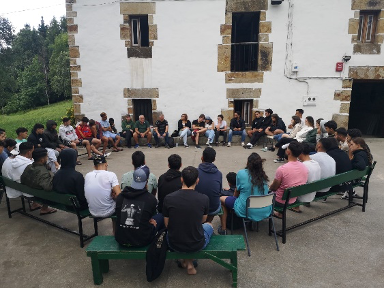
Summer is not a time of closure for the Calasanz Movement. On the contrary, it is a time used especially by our children and youth to live in groups and grow in humanity and Christianity. The summer camps are an incredibly important activity for all groups, serving to consolidate group life and to learn the Piarist style we aspire to.
In addition to the camps, the young people are offered a wide range of personal opportunities to help them discover their place in the world following Jesus in the Calasanz style. We call them Foundation Experiences, which range from unique retreats, social volunteer camps, joint meetings and community experiences… Through them, we work intensively with young people to share life in a group, the care and spiritual growth of each individual, commitment to the most disadvantaged and an alternative lifestyle to contemporary society.
On our Emmaus Province website, there is a section where we gather these Piarist experiences coordinated by the Calasanz Movement and ITAKA-Escolapios, as well as other nearby institutions. Any young person who fits the general profile required by each experience can see the variety of proposals and sign up. https://experienciasmc.itakaescolapios.org/
We update this website every year so that young people’s carers can assess which experiences they should go on, depending on their personal situation and time in the pastoral process.
A fundamental aspect is that many of these experiences require one or more meetings before and after the actual experience for their preparation and assimilation from a faith perspective in order to make the most of what is on offer.
Another fundamental aspect is that young people are protagonists and participate in the development and implementation of the experience as active subjects of the mission. With their voice and their co-responsibility for the proposal, which we were encouraged to do by the Youth Synod 2018.
A final aspect is that these are experiences that seek to respond to the calls of God in today’s world by seeking the signs of the times with new languages. It is about connecting young people to the Gospel message, because we want the young people in our groups to move from consuming experiences to consuming processes of personal and spiritual growth that transform them and form them as Christians.
With this in mind, this summer, in addition to the usual camps with children and young people, we had the following experiences with young people:
About 15 young people lived for a month in the Piarist provinces of Mexico, Cuba, Bolivia and Brazil, sharing the life and mission of the Piarists. One of them, Jon Ameztoi, tells us what resonates with him today.
After spending a month in Bolivia, mainly in the boarding school and school of Anzaldo, but also in other places of Piarist presence and work, two things changed me the most.
The first was the witness of the many Piarists I met. They were of different ages and backgrounds, but in all of them, I saw a vocation to service and a love for the children of the school that moved me. They were a testimony to God’s mission to the children, especially the poorest.
From my European perspective, the second was the approach to poverty that I had not known before. It was with the neediest that I had the most evangelical experience of God. In a way, I understood what Calasanz might have felt in the Trastevere of 400 years ago.
More than 20 young people from the catechumenate of the different Piarist presences participated for five days in two work camps, one in the hostel of Txamantxoia and the other in the hostel of Arrázola, together with young migrants from our homes. They worked together, made different arrangements in the shelter, learned, lived together and shared life. They return with recharged batteries for the new school year, full of enthusiasm and motivation and eager to work to make this world a better place. Zakaria Ouadou, a participant of APM (Acompañamiento a Personas Migrantes) in Bilbao, tells us about his experience:
The farm week was a spectacular experience, I will tell you why, and what it was like in this text.
Now, when you hear the word “work camp”, at first I think that we just go to work and so on. But the truth is that it is not what we thought; it is better.
The week at the farm was the first time I had the opportunity to try ITAKA. I enjoyed it very much and I am glad that I was able to spend it.
This week helped us a lot, especially psychologically and socially, to get away from the noise of the city. Moreover, the activities we shared (games, work, mountains…) allowed us to integrate with colleagues from other cities (Zaragoza, Logroño, and Seville). Of course, they were very friendly. What I also liked most was the trust and connection between us. In addition, of course, meeting our comrades from ITAKA allowed us to get to know each other well. The activities we did also had a positive impact on us. The swimming pools, playing football, horse riding, we not only had fun, but we also learned a lot: to be considerate of others so as not to hurt each other, to help without asking, teamwork, sharing, etc…
Finally, we had to go and part and it was hard for us to say goodbye to our comrades. After all the good times, there was sadness, tears, joy, laughter and mixed emotions. The truth is that it was an unforgettable experience. We will have another opportunity to have this new experience. In addition, I would like to thank our trainers who accompanied us through everything: Thank you to Andoni, Eboni, Markel, María.
Another 12 young people were in Ceuta, on the Spanish border with Morocco, to support the reception of young migrants crossing the fences at the Temporary Stay Centre for Immigrants (CETI). Ángel Martínez, the coordinator of the action, tells us what he experienced.
Nervousness, pent-up emotions, uncertainty, the desire to share, excitement…
As we all waited in the port of Algeciras for our ferry to Ceuta, our emotions danced within us. We would open a labour camp on CETI the autonomous city.
Monitors and young people had told us that it would be intense, that we would experience real stories of life and overcoming, of struggle and despair, and perhaps one of the biggest concerns we had was how we would communicate. We had planned workshops, communication opportunities and activities that would be done.
Nevertheless, it was much easier than that.
Very soon, from the very first moment, we realised that our hearts connected with an unexpected ease. Soon, very soon, we realised that communication flowed, because when two people want to communicate, there are no barriers that stand in the way.
Our hearts narrowed by the minute, but over that a pure and hopeful heart was forged.
We touched the poverty in Ceuta and yet were flooded with the affection, the calling and the dedication of the dozens of workers and volunteers with whom we shared the work camp.
We touched the wounds in Ceuta, but we did not fail to see in dozens of eyes the hope of coming to the peninsula to look for work, to forge a future and not to stop helping each of us to support our own.
We almost touched the fence of shame in Ceuta, but we felt it touched us deep inside to imagine the faces we had connected with our hearts, squatting on the barrier that we men had erected and that the seagulls kept flying over.
And someone had touched our hearts, without a doubt: the reflection on the beach, the spontaneous prayer in front of the fence and the silence on the way back were proof of that.
We returned in silence on the Valeria, which the inhabitants of CETI call the Balearia ferry, the bearer of hope. There was no longer a young feeling for the experience to be lived. In our hearts was the merging with our brothers, with other children of God with whom we share the dream of crossing the strait on the Valeria to reach at least part of the promise of life in a somewhat more just world. The silence we entered on the Valeria was not just because of the farewell looming over us; it was the silence of those who knew that this was not just another journey.
To conclude these lines, I would like to bring a short text written by one of the young women who participated in the work camp and recited in an evening prayer. Her lines bring us closer to the mixture of feelings, hope and hard reality that we experience every day.
“Dear brother, today I met a boy your age. He told me that he wants to be a doctor, just like you. You are about to enter your third year of medical school. If he is lucky, he will go to the Peninsula. You have chosen medicine because your father has insisted on it. His parents cannot support him in his decision because they were killed. He wants to be a doctor and I did not dare tell him that he will not be able to do it. But what if he could?”
Other young people have participated in volunteer camps in other institutions with prostitution and minors (Oblates, Jesuits…). Janire Díez, for example, lived with the Oblates in Alicante and she tells us about it:
We are three young women who have seen the harsh reality in which women live. Women, who seem to be able to have everything, some married, some not, with children… Behind this façade is abuse, rape, coercion, psychological or physical abuse… a series of acts that destroy a woman and every human being.
Many of the women we met are fighters trying to get out of this situation, women with a big heart who want a life away from all this. All this makes us realise that we have to keep fighting for change.
We have to keep fighting for them and for social change so that no woman has to endure being raped, being locked up in her own house, begging for her life, being unhappy, being a leftist and whatever else you can think of.
Several groups of young people have been in the community of Basida in Navahondilla.
Hello, I am Isabel López de Ocáriz from Vitoria and this summer I had the good fortune to spend four days at Basida House in Navahondilla.
First, I have to admit that from the moment I arrived, I found the place very welcoming, and as the days went by I realised that I was part of a big little family.
I was amazed at how the people, all volunteers, worked and the best part was seeing how the residents themselves supported each other and helped each other as much as they could without thinking that they were better than the other despite their different abilities was.
From the beginning, the residents treated us like family, letting us into their stories and giving us life lessons.
I will take away some lessons from this, but most importantly, as one person in charge told us, “None of this would have been possible without God”.
I look forward to coming back and learning from them!
Another longer testimony comes from the group from Pamplona who were in the Basida community in Aranjuez: Iker Sanz, 20 years old.
With fear and uncertainty. So I came to Basida, a volunteer camp I had signed up for without knowing exactly what it was about (I only knew it was founded after the outbreak of AIDS in the 90s), because during the course I almost cannot go to any meetings of my catechumenate group, as I study in Zaragoza. Therefore, it was a good opportunity to do my part and participate in the Calasanz movement.
The closer the date got, the more I learned about what I would experience. I found out that Basida was not only hosting people with AIDS, as it was in the beginning in the 90s, but that they had gradually opened up to other realities: people with drug and alcohol addictions, people with dementia, immunodepression, family abandonment, displaced people, chronically ill people or even sick prisoners serving their sentences in Basida’s house. In other words, there were endless cases to which I could not find any reference or concreteness, which made me even more nervous than I already was. To make matters worse, an antigen test was done as a precaution when we arrived, and it came back positive, so I had to wear a mask at 37°C for a few days. Overall, my desire and appetite to have this experience was low at first.
However, in the course of the first day, I started to see everything differently. We went to a snack bar and the first thing that surprised me was the atmosphere. I had expected Basida to be a “medical” centre, like a nursing home. Instead, I felt a much more family atmosphere, much more like a home than a doctor’s office. The residents sat with the others. The residents sat at tables of 4 with the other volunteers, and we, who were shy at first and did not know what to do, sat apart from them. The first lesson came when some residents approached us to introduce themselves, welcome us to Basida, and let us know that they were happy that we were coming. Also, I was sitting alone at a table as a precaution, so they came up to me to ask my name and see how I was doing. At that moment, my perception of the situation changed and I began to shake off certain prejudices about the residents. I thought it would be much more difficult to have a conversation with them because they would have a more aggressive attitude, especially when you think of the inmates or addicts. However, you realise that they are not bad because of what they have done, but they are damaged by their circumstances.
Every morning we were given different tasks to do in the house, which we also did together with the residents and which they even took into their own hands. These included cleaning up the storerooms, helping in the kitchen and pantry, helping the “peques” (the most dependent people in the house), laundry… Although they are very grateful for our help, I thank them because these moments were an excuse to talk to the residents, to get to know them a little better, both them and the story behind them. There was no need to ask them anything, because they needed to feel that they were being listened to, and they opened up to all of us. From “banal” conversations like the one with Marcos about the duties of an orchestra conductor or the one with Roberto about Raffaella Carrá, his favourite singer, to Toño telling about his drug problem and Maite explaining what the Basida family means to her. But they all seemed happy with their progress and their current life there.
On the other hand, we had training on different areas such as health, psychology or social issues. I enjoyed learning about the different diseases we find in Basida, the different ways of dealing with the other profiles and what the Basida team does when a new case comes to them. However, it was the first introduction day when Cristina, one of the founders of Basida, explained that it is a purely voluntary project. They are not employees, but volunteers and have no work outside Basida House, but their lives consist of helping the residents, being there for them and maintaining the community. Basida is supported by donations or grants, but the volunteers have no income or contributions. One question that came up for all of us was what will become of them when they are old, as they will not have a pension. Cristina answered: “Well, someone will take care of me here when I am old, we all trust that”. It is a risky life plan, but at the same time with an extraordinary philosophy and background of love. It’s not only surprising in itself, but even more so when you learn that at our age, around 20, they chose this way of life, something that, at least in my case, I never considered and that you can not even easily imagine. We learned a lot from Cristina, Visi, Juan Carlos, Félix and Arantza.
Finally, I would like to highlight the spirituality that surrounds this whole project, because for the founders, faith was the main driving force behind it. It is hard to believe that they survived the first five years when they had to lose many residents because of the lack of knowledge about HIV infections, but they did it because they believed in God. Even though many of the residents went to Eucharist on many days to see people like Linda, Juanan, Leo or Isa (some of the “little ones”) singing, praying, praying for their families and, above all, smiling in the face of their undoubtedly complicated situation, I do not think it leaves anyone indifferent.
With illusion and hope. Therefore, I left Basida with the illusion that I could take all that I had learned about life and the Basida philosophy to my surroundings, in some way pass it on, and implement it in my daily life. In this kind of experience, the mixed feelings are limited in time and space. By this, I mean that it is no use being excited one week you spend in Basida and the following week when you tell your family and friends what you have experienced. You have to figure out how to incorporate what you have experienced into your life, how to make it fit your ideals, and how to put it into practise. Finally, I hope for two reasons: The first is that young people like us have brilliant ideas and great courage to help people with their skills who have nowhere else to turn or want to turn.
The founders of Basida more than 30 years ago are an example of this, and hopefully we can be a similar example at some point in our lives. The second reason lies in the people who entered Basida with unimaginable and seemingly irreparable problems and are now living every day and reformed lives; they are renewed people. Many of them are now volunteering to help people in whom they actually see their reflection from a few years ago. Undoubtedly, this is another sign of the Basida family: a family that leaves no one indifferent and whose essence is based on diversity, a sense of community and unconditional love.
In its second edition, five other young people from different presences in Rome have lived Close to Calasanz. This is a pilgrimage of young people from the Calasanz Movement in Europe to share their experiences of the Calasanz Movement and to grow in Calasanctian and Piarist identity. Our five young people have enjoyed talks, dialogues, visits, meetings with Father General and Carles Gil, retreats in Assisi… enjoyed. They return with a great desire to multiply this enthusiasm for our charism. We can read three of their testimonies:
Sebastian Romaniak, Poland. The “Close to Calasanz” trip was a fantastic experience for me. Not only did it introduce me to the character, charism and mission of St. Joseph Calasanz, but it was also a great opportunity to connect with others. The most emotional moment for me was working with the children. I also have fond memories of meeting Pedro, the General Father of the Piarists Fathers, who told us about the reality of the Piarist Order. This trip will always remain in my heart!
Miriam Marquez, Spain. “One of the things I liked most about the trip was seeing how all the different environments around us allowed us to connect with God. From the beautiful churches in Rome, to the nature in Assisi, to the beach with the kids at Calasanziants or General House. Places where we opened our senses to pray, laugh, enjoy and feel closer to Calasanz”.
Emőke Martos, Hungary: “Father General asked us in Rome what lives in our hearts. At the youth meeting near Calasanz, the young people from the European Provinces and their companions approached me. I am comforted by the now personal conviction that we all live for the same values and dreams, even if we live far apart. We are not alone, for God has implanted the desire to meet and accompany children and young people in many committed hearts. From Rome, I brought movement, noise and joy of life, from Assisi peace and silence. Following the example of Calasanz, we can decide for Jesus anew every day, even if we have not done so before. A new day – a new opportunity. Thank you for the experience and the conviction.
May Calasanz accompany you all on your journey.
Juan Carlos de la Riva
