The Pious Schools’ college and church in Valencia, founded by the Piarists in the 18th century, serves various cultural functions, including education and events. The church features a notable dome, the largest of its kind in Spain, which faced significant structural issues, prompting a comprehensive restoration initiated in 2021. This included geophysical studies, the installation of scaffolding, and the careful restoration of tiles and structural elements. Innovative methodologies, such as 3D laser scanning and traditional craftsmanship, were employed. The site also hosts guided tours, concerts, and a museum showcasing significant artworks and historical artifacts, emphasizing its rich cultural heritage.
Keywords:
Escuelas Pías, dome, work, methodology
Value and significance of the monument.
In 1597, Saint Joseph of Calasanz founded the first public school in Rome, as only the wealthy classes had access to education, naming it “Pious School.” The order known as the Piarists arrived in Valencia in 1737, where they began construction of the school in 1739 and completed it in 1747. In 1767, work on the church began according to the plans drawn up by the master builder Josef Puchol. The promoter of the works, Archbishop Andrés Mayoral, desired a church whose design would stand out from the traditional Valencian architectural style, sending the architect to visit the church of the Bernardine Nuns in Alcalá (Madrid). Today, more than a thousand students and their teachers are the daily inhabitants of this Cultural Heritage site.
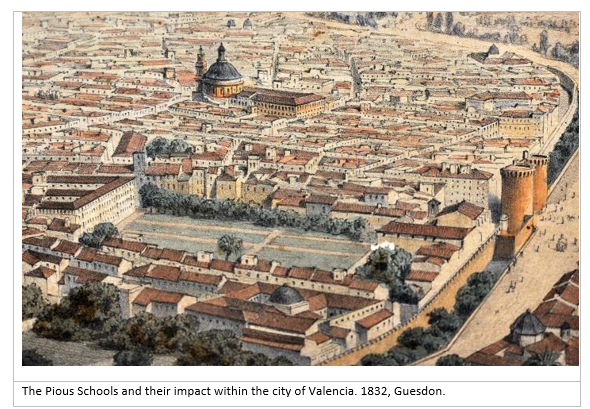
The Pious Schools’ college and church are located in the historic Velluters neighborhood, integrated within the Special Protection Plan of Ciutat Vella, occupying almost the entire area of a rectangular block, except for the eastern corner. The school is rectangular in shape, and at the eastern end is the church; it is nestled between the main façade with the bell tower (south), two wings of the school cloister (west), an alley (north), and residential buildings and a courtyard (east). The dome of this church is a landmark of the Velluters neighborhood, which was very important in the 18th century due to the existence of multiple silk workshops, hence its name “Sederos.” The church is the religious seat of the carpenters’ guild, and it was traditional to hold the Fallas Mass (Intangible Cultural Heritage of Humanity) on Saint Joseph’s Day, the patron saint of carpenters.
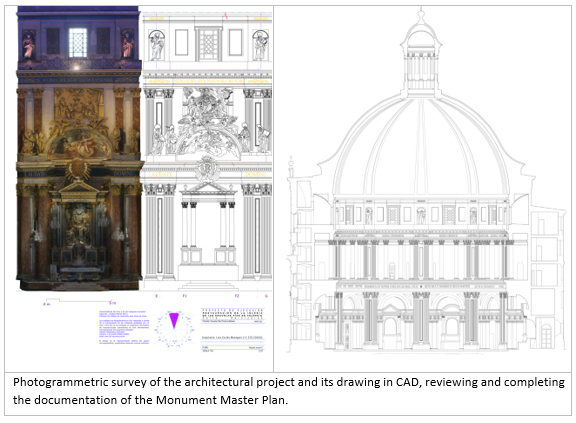
The church was initially designed and overseen by José Puchol until he was replaced by Antonio Gilabert in 1768, who also revised the project. However, the construction was halted in 1769 due to the death of Mayoral and a lack of financial resources. After delays caused by funding shortages, the church was finally completed in January 1771 and consecrated in 1773. The interior layout is circular, featuring ten exedras situated between trapezoidal piers that are 3 meters thick, with space for two entrances, the main chapel, and the remaining seven chapels. Additionally, one of these chapels provides access to the space between the main façade and the church structure, where the staircase leading to the upper levels and the bell tower is located. The wall encircling the church is approximately 50 cm thick.
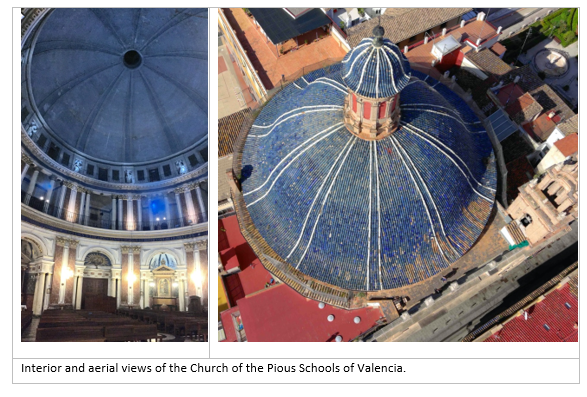
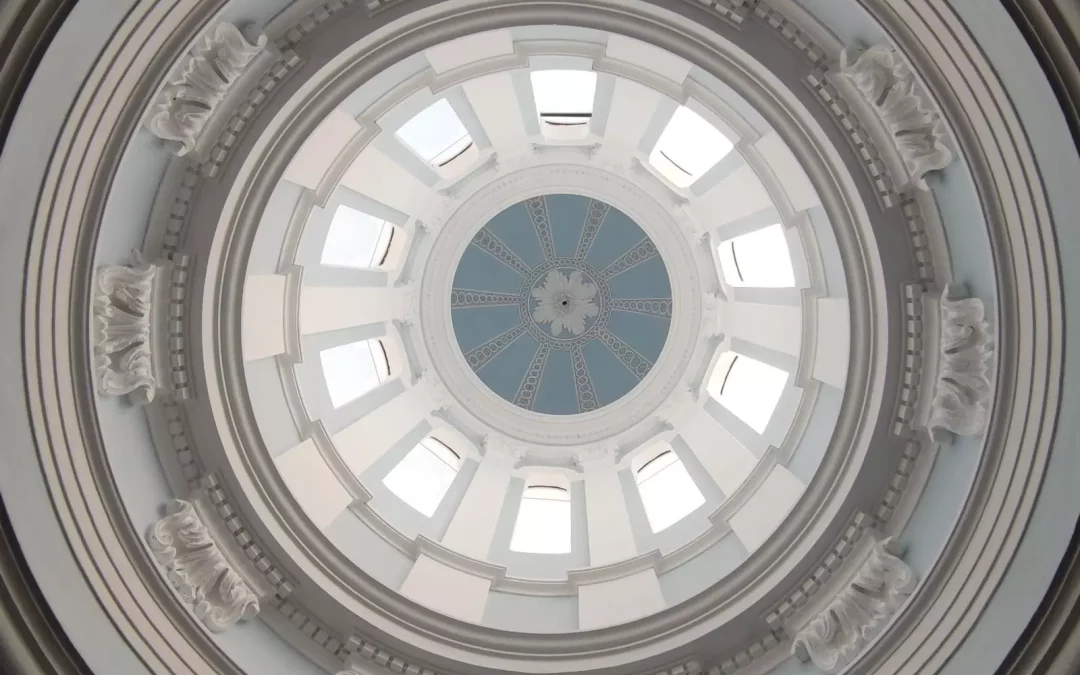
The second level includes spaces between buttresses and a gallery with a railing, forming a tribune for the choir and other uses. The third level begins at the upper cornice at 21 meters, where there are niches for the ten apostles and the windows forming the drum. The next level is the dome, which, with its 24.5-meter diameter and almost 1000 square meters of surface, is the largest dome with blue tiles and is included among the prestigious group of great European domes. In terms of interior size, it is the second-largest dome in Spain, only surpassed by San Francisco el Grande in Madrid, designed by the Valencian Franciscan Cabezas.
The classicist architecture of this centrally planned church has notable compositional parallels with the Pantheon of Agrippa and the Minerva Medica, both in Rome, due to the double coincidence of the diameter’s dimension and the articulation into ten exedras, which support the vaulted space. The construction of this “Rotunda” represents the architectural embodiment of academic ideals in the final third of the 18th century, culminating the path initiated by the enlightened circle of Tomás Vicente Tosca. Moreover, it is one of the milestones in the history of masonry, being mentioned by Rafael Guastavino himself in his book Essay on the Theory and History of Cohesive Construction, applied especially to the Timbrel Vault (1893).
Context in which the intervention was carried out; state of conservation and use before the start of the work, and the results achieved.
The poor condition of the dome’s covering and the existing cracks in four of the ten sectors necessitated the drafting of the Master Plan by Rafa Soler’s study in the 1990s. However, the only interventions focused on the facades, as the high cost and the difficulty of intervening on the largest blue dome in Spain delayed the intervention.
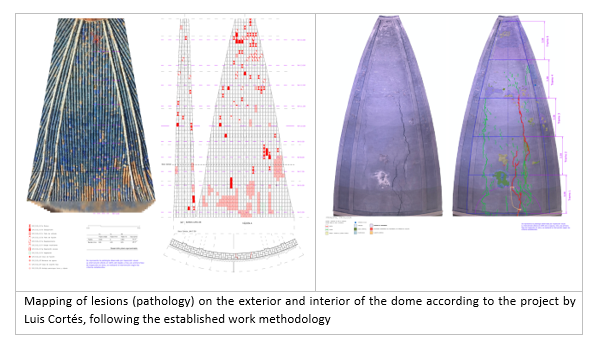
In 2016, the basic project was completed, and by 2021, after Luis Cortés (Universitat Politècnica de València) drafted the plans for the comprehensive restoration of the church, funding for the restoration of the dome was secured through the ‘Ministry of Development’ in the 2022 State Budget.
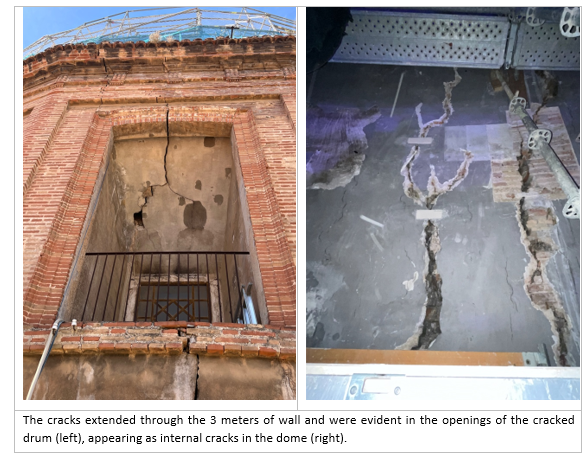
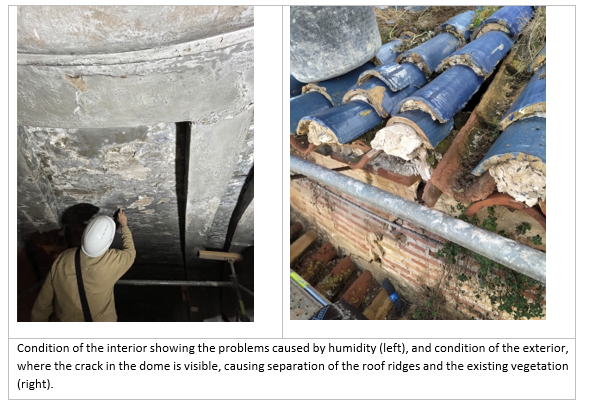
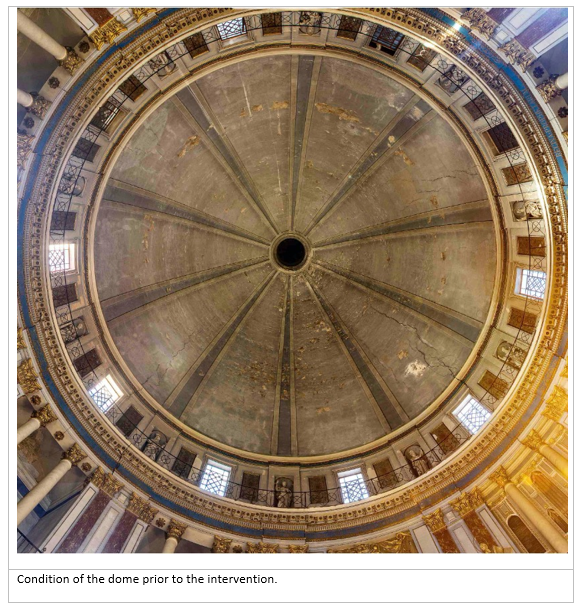
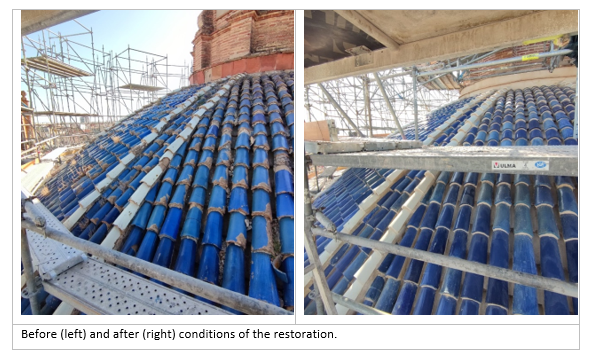
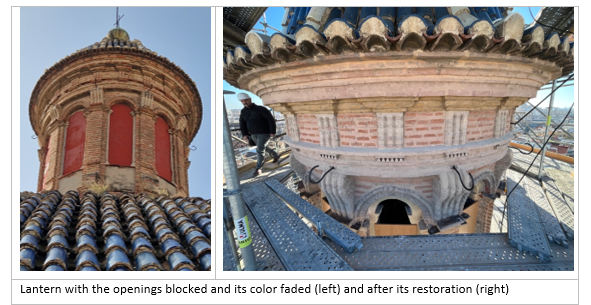
The dome had four large cracks in the shell that extended from the interior to the exterior, as well as cracks in the drum, and two roof ridges had shifted, allowing water to infiltrate inside. The tile covering was in a very poor state of conservation, with water infiltrations causing dampness, salts, and loss of plaster, among other issues. On the exterior, there were numerous broken tiles, vegetation, missing tiles, and tiles with loss of enamel. Additionally, the lantern had its openings blocked with honeycomb brick and red waterproof paint.
Work methodology
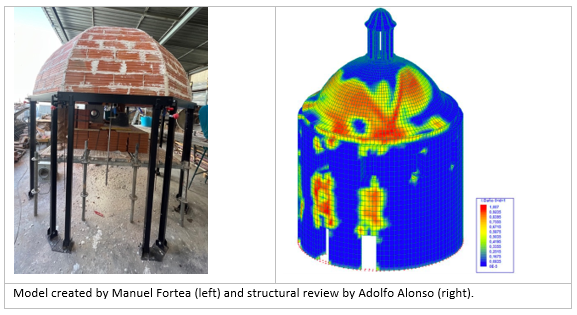
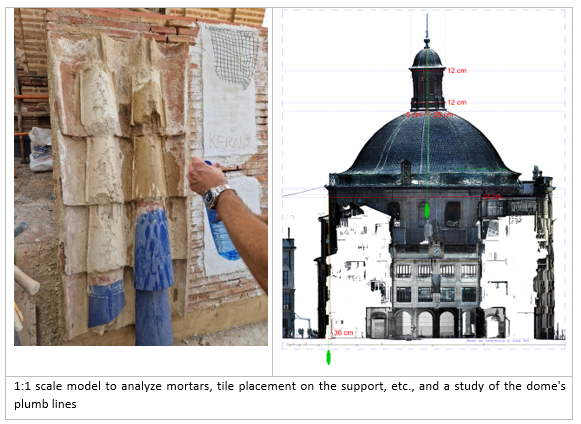
Before the start of the work and in parallel with the drafting of the project, various studies were conducted to decipher the origin of the cracks. An experiment was carried out using a dome model designed by Manuel Fortea to test for breaks in domes and the collapse of the model. A 1:1 scale model was also created to test the cracks, along with mortars that would be part of the work and the system for placing the tiles. Additionally, a thermal camera study was conducted in collaboration with Jaume Coll (Director of the National Museum of Ceramics and Decorative Arts González Martí) to investigate the pathology of the blue tiles.
The project’s criterion and intervention approach was to respect the materiality of the monument, establishing that the building itself is the Master. Therefore, various studies and tests were carried out to understand the structural pathology and construction composition. This project was not about reconstructing the tile roof, but rather, as Le Corbusier would say, about restoring the ‘fifth façade’ of this unique church. Being a dome, this is even more significant as it is the most representative element of Valencian historical architecture, being the largest of its kind and part of the prestigious group of great European domes.
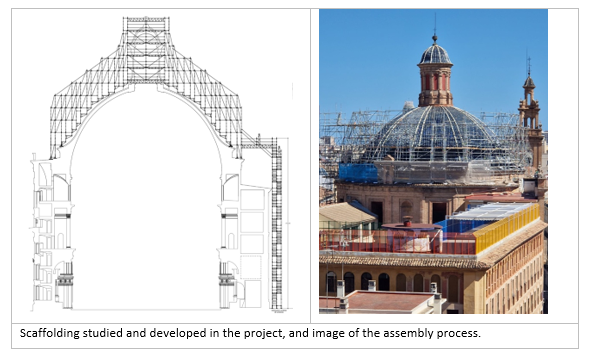
The study of the project began with a detailed analysis of the scaffolding—one year of work—and its placement, as it could not rest on the dome due to the large cracks present. The scaffolding had to span a 31-meter distance, requiring a 75-ton structure that was supported entirely on the drum, which itself also had cracks.
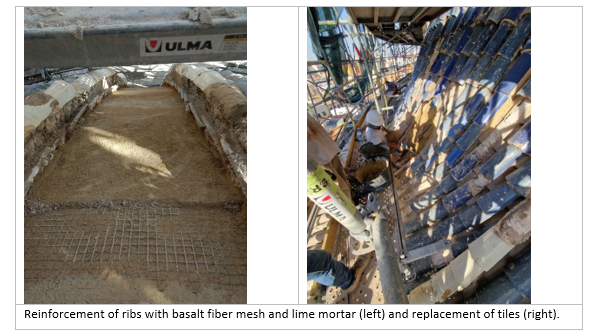
Since the dome had cracks, after studying different mixtures based on their fluidity, they were filled with lime grout and, in some cases, with a small amount of sand. The repaired dome will never behave as it did on the first day, but it is crucial to ensure permanent contact in all parts to guarantee its three-dimensional behavior. Similarly, in the area of the cracks, and to improve its performance against earthquakes or movement, the bands of the 4 cracks and the 10 ribs were reinforced on the exterior with a 2 cm layer of traditional lime mortar and basalt fiber mesh. This composition was tested on a 1:1 scale model at the construction site and compared with other industrial mortars, yielding an adhesion coefficient of 0.6 kp/cm², higher than that of other well-known international brands.
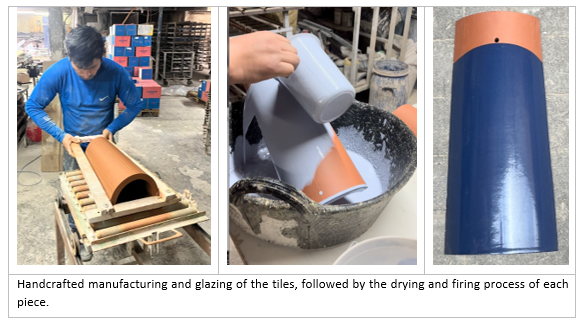
The dome covers an area of approximately 1,000 m², which corresponds to around 32,000 tiles—half (16,000) being ‘river’ tiles and the other half the ‘cover’ (blue) tiles. Of these, 7,000 tiles, or 44%, had to be replaced. A chromatic study was conducted, revealing up to four different types of tiles, each with its own shade of blue. For the restoration, the tiles were handcrafted to replicate the four different blues and were installed by specialized personnel, following traditional methods. The mortar used was traditional lime mortar. To preserve the originality of the work, any tiles with missing enamel were touched up with a glaze of the same color, a process carried out by a specialist restorer
A monitoring system has been installed at the four cardinal points to assess the thermal characteristics and behavior of the dome, with sensors measuring temperature, relative humidity, and CO2 levels both inside and outside, as well as laser distance meters to check for tilts or settlements.
One of the most significant aspects is the reopening of the lantern openings and the restoration of the original color of the lantern using a lime glaze, as it was in the 18th century.
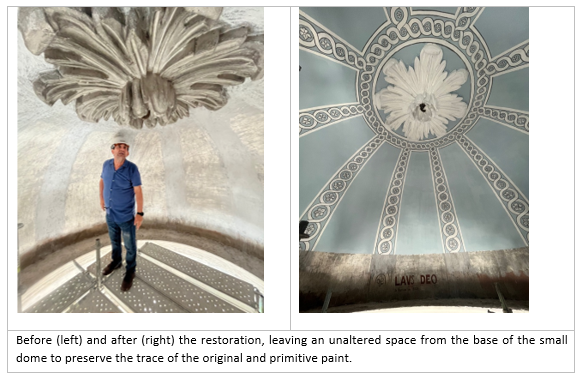
On the interior, the lantern has regained its natural lighting, and the original decoration has been restored, featuring a design of interlinked circles with central flowers. This decoration is similar to what Gilabert designed for the Neoclassical renovation of Valencia Cathedral.
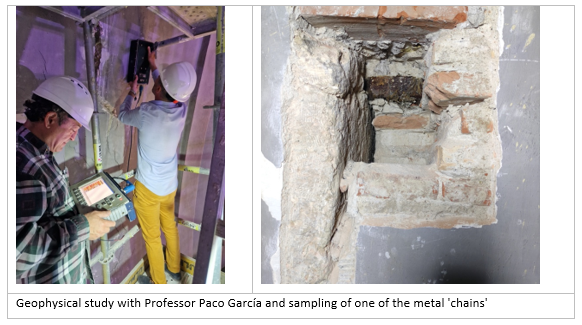
In order to understand this entire construction artifact, a geophysical study (Non-Destructive Testing) has been used to locate the metal rings mentioned by Zacarés in the 19th century within the dome, which Guastavino also references, establishing the most accurate construction hypothesis for this dome. Additionally, 3D Laser Scanning (TLS) surveys have been conducted to create a comprehensive record of the monument during the phases of the project (before, during, and after) for future maintenance with HBIM.
New uses, management, and maintenance. Innovative aspects of the intervention.
The use of this church is varied, but always from a cultural perspective; it still serves an Eucharistic function, in addition to being the event hall for the school. Furthermore, due to its acoustics and the spectacular nature of its architecture, concerts are held there, and it also has a museum function, as the church’s gallery houses the Escola Piart exhibition, a collection of artworks from the school, featuring pieces by artists such as Segrelles, Pinazo, and Benlliure, along with a painting attributed to Goya. The exhibition also includes important books, such as an incunable by Nebrija (15th century) and the first history of Valencia written in Valencian from the 16th century, as well as a collection of ornaments and liturgical vestments dating back to the 16th century.
In the staircase leading to the gallery, visitors will find the museum of the work, where they can see original ceramic pieces, images, and models to better understand the construction and restoration of the dome 250 years after its construction.
The intervention has received total and direct funding from the Government of Spain, without the need to apply for other grants.
There is a team that manages the heritage and the interventions to be carried out, as well as being responsible for requesting and managing grants for the conservation of this monument.
Guided tours of the church are conducted by a specialized company, and classical music concerts are also held by candlelight.
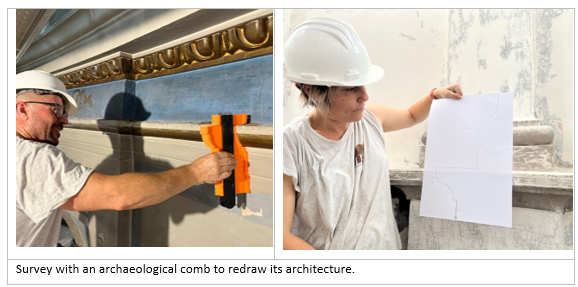
The most innovative aspects of the intervention include a detailed study conducted before and during the project, establishing an optimal work methodology. This highlights the studies for implementing a 31-meter span scaffold weighing 75 tons over a cracked drum; geophysical (non-destructive) studies to locate the iron chains inside the dome; the Flat-Jack test to assess the working tension of the dome; sampling to uncover the interior decoration and the coloration of the exterior; and modeled studies, particularly the solar study, which revealed the illumination of the main altar on the feast day of the church’s patron saint (Saint Joachim). The architecture has been redrawn using archaeological combs; the pathology of the tiles has been studied with Dr. Jaume Coll (Director of the National Museum of Ceramics and Decorative Arts González Martí); tests and analyses of mortars, coatings, paints, etc., have been conducted; the behavior of the dome has been studied using a real model; the dome has been equipped with sensors for indoor and outdoor humidity and temperature, CO2, and laser distance measurement; and a 3D laser survey has been carried out to check for tilts and for its future management with HBIM.
Traditional craftsmanship has also been employed for the manufacturing of tiles, the execution of traditional masonry techniques, and the restoration of the lantern of the dome to its original state.
Guided tours and technical workshops have been conducted for site visits, involving professional associations of Architecture and Technical Architecture, as well as students from the Polytechnic University of Valencia and the University of Valencia. Recently, symposiums have been organized, the first being held by the Royal Academy of Fine Arts of San Carlos in Valencia prior to the execution of the work to discuss technical issues, featuring the participation of renowned national researchers such as Rafael Soler, Adolfo Alonso, and José Luis González Moreno, along with the attendance of heritage managers from the administration and notable figures in architectural restoration, including Julián Esteban Chapapría, José Ignacio Casar Pinazo, Elisa Moliner or Luis Almena. Another symposium was organized by Luis Cortés and Manuel Fortea as part of the Master’s program in Architectural Heritage Conservation (UPV), focusing on Valencian vaults and addressing the project and restoration work of the dome.
Research articles have also been published in prestigious journals, and there have been repeated news reports in the media, both in print and audiovisual formats.
A one-hour documentary about the work and the monument is currently being produced, and the trailer has recently been uploaded to YouTube.
A couple of years ago, a short film about the monument was also uploaded to YouTube.
A complete scan has been conducted using a 3D scanner, and images have been taken with drones. The implementation of monument maintenance using BIM applied to heritage (HBIM) has already begun, with the collaboration of expert Jorge García Valldecabres.
Luis Cortés Meseguer, architect
REFERENCES
Alonso Durá, A. & Martínez Boquera, A. (2003). Diagnóstico sobre el comportamiento estructural de la cúpula de las Escuelas Pías de Valencia. In Restauración & rehabilitación, 74, 54-57.
Barba, S., Di Filippo, A., Cotella, V.A., & Ferreyra, C. (2021). BIM Reverse Modelling Process for the Documentation of Villa Rufolo in Ravello. In DisegnareCON, 14 (26): 1.1-1.11.
Bérchez, J. (1983). Iglesia de las Escuelas Pías. In Joaquín Bérchez (Ed.) Catálogo de Monumentos y Conjuntos de la Comunidad Valenciana (pp. 492–504). Valencia: Generalitat Valenciana, Conselleria de Cultura, Educació i Ciència.
Bérchez, J. (1987). Los comienzos de la arquitectura académica en Valencia: Antonio Gilabert. Valencia: Editorial Federico Domenech S.A.
Castellanos Gómez, R. (2012). Plan Poché. Barcelona: Fundación Caja de Arquitectos.
Cortés Meseguer, L. & Ramírez, M. (2023). Informe del estado de las obras, mes de febrero. Inédito. Ministerio de Transporte, Movilidad y Agenda Urbana.
Crespo Godino, D., López González, M.C. & García Valldecabres, J. (2014). Estudio murario y documental del origen de San Juan del Hospital de Valencia. In EGE Revista de Expresión Gráfica en la Edificación, (8), 44–50.
Fanelli, G. & Fanelli, M. (2022). La cúpula de Brunelleschi. Historia y futuro de una grande estructura. Florence: Mandragora.
Fortea Luna, M. (2013). Análisis estructural de bóvedas de fábrica. La eficacia de la geometría. (Doctoral dissertation). Universidad de Extremadura, Spain.
Gil Saura, Y. (2015). “El miedo a levantar las cúpulas en la arquitectura valenciana del siglo XVIII: los tambores”. In Piazza, S. (ed.), Saperi a confronto. Consulte e perizie sulle criticità strutturali dell’architettura d’età moderna (XV-XVIII secolo). Palermo: Caracol.
González, J. L. (2023). Estudio sobre el comportamiento estructural a acciones gravitatorias de la iglesia de las Escuelas Pías de Valencia. In Simposium Escuelas Pías de València, el panteón valenciano. Abierto por obras. Valencia: Real Academia de Bellas Artes de San Carlos. Not published.
Guastavino. R. (1893). Essay on the theory and history of cohesive construction, applied especially to the timbrel vault. Boston: Ticknor and company.
Huerta, S. (2004). Arcos, bóvedas y cúpulas. Madrid: Instituto Juan de Herrera.
López-Manzanares, G. (2023). Technical reports and theoretical studies about the structural behaviour of masonry domes in the 18th century. In Frontiers of Architectural Research 12, 42-66. https://doi.org/10.1016/j.foar.2022.06.012
Marín Sánchez, R. (2021). El proyecto para la Rotonda de las Escuelas Pías de Valencia (1767-1773). Una mirada técnica. In Gómez-Ferrer, M. and Gil Saura, Y. (Ed.) Geografías de la movilidad artística. Valencia en época moderna. Valencia: Cuadernos Ars Longa, nº 10.
Martínez Garcés, (1995). Estudio geotécnico iglesia de las Escuelas Pías de Valencia. Inédito.
Masi, F., Stefanou, I. & Vanucci, P. (2018). On the origin of the cracks in the dome of the Pantheon in Rome. In Hal. https://hal.archives-ouvertes.fr/hal-01719997v2
Ponz, A. (1774). Viage de España, ó cartas en que se dá noticia de las cosas mas apreciables, y dignas de saberse, que hay en ella. Tomo Quarto. Madrid: Joachin Ibarra
Rodriguez-Navarro, P. & Gil-Piqueras, T. (2020). New Contributions on the Escuelas Pías Dome in Valencia. In Nexus Network Journal, 22(4), 1081–1098. https://doi.org/10.1007/s00004-020-00500-5
Rodríguez-Navarro, P., Cabezos Bernal, P., Gil Piqueras, T. & Giménez Ribera, M. (2022). Using drones under 250 g for documentating the architectural heritage. In DisegnareCON, 15 (29).
Real Academia de San Carlos (1770). Libro de actas de 1768-1786. Junta general de 21 de Enero de 1770 y 18 de abril de 1770. Valencia: Not published.
Soler Verdú, R. & Benlloch, J. (2023). Estructuras históricas. Estudios sobre la estabilidad y la seguridad estructural. Modelos de daños y causas; el caso de la rotonda de las Escuelas Pías. Simposium Escuelas Pías de Valencia, el Panteón Valenciano. Abierto por obras. Valencia: Real Academia de Bellas Artes de San Carlos. Not published.
Soler Verdú, R. (1993). Plan Director Iglesia Escuelas Pías. Valencia: not published.